Cardiology

Does Heyde Syndrome (The Association Between Aortic Stenosis And Intestinal Angiodysplasia) Exist?

September 29, 2010
Does Heyde Syndrome (The Association Between Aortic Stenosis And Intestinal Angiodysplasia) Exist?

By Laura Dunn, MD

Faculty Peer Reviewed 

In 1958, EC Heyde published 10 cases of aortic stenosis (AS) and arteriovenous malformations (AVMs) of the gastrointestinal tract in the New England Journal of Medicine .  Thus, the association between aortic stenosis and intestinal angiodysplasia became known as Heyde Syndrome.  Yet the existence of this syndrome has been controversial. 

 Contrasting conclusions have been obtained by studies conducted to evaluate this association.  In a prospective study, Bhutani and colleagues did…

Read more »

The Heart in Acromegaly

September 1, 2010
The Heart in Acromegaly

By Ari Pollack, MD

Faculty Peer Reviewed

 The onset of acromegaly is subtle, and its progression is usually very slow. In fact, the usual interval from the onset of symptoms until diagnosis is about twelve years. The manifestations of acromegaly result from excessive secretion of growth hormone (GH), which targets the liver, resulting in stimulation of hepatic secretion of insulin-like growth factor-1 (IGF-1), which causes many of the clinical manifestations of acromegaly.  The most common cause of acromegaly is…

Read more »

Selected Discussion of Presentation From The American College of Cardiology 59th Annual Scientific Sessions

August 24, 2010
Selected Discussion of Presentation From The American College of Cardiology 59th Annual Scientific Sessions

By Robert Donnino, MD

Faculty Peer Reviewed

The 59th Annual Scientific Sessions of the American College of Cardiology (ACC) took place in Atlanta on March 14-16, 2010. Despite inclement weather in the northeast causing the cancellation of many flights, a large number of NYU faculty, fellows, and others made it to Atlanta to give talks, presentations, or simply attend the conference.

As usual, the Sessions presented us with many important studies from around the world, some of…

Read more »

Appropriateness for Revascularization in Stable Angina

July 22, 2010
Appropriateness for Revascularization in Stable Angina

Ramin Shayegan Hastings MD, Jonathan Willner MD, and Steven Sedlis MD

Introduction to Cases:

During the past several weeks, we have posted a series of cases addressing the appropriate treatment for patients with stable coronary artery disease. We have focused on indications for revascularization in stable angina. In all of the cases, the patients have been at high enough risk that stress tests and coronary angiography are performed.

There has been recent data and recommendations on the appropriate…

Read more »

Appropriateness for Revascularization in Stable Angina

July 1, 2010
Appropriateness for Revascularization in Stable Angina

Introduction to Cases:

During the upcoming weeks, we will post a series of cases addressing the appropriate treatment for patients with stable coronary artery disease. We will be focus on indications for revascularization in stable angina. In all of the cases, the patients will be at high enough risk that stress tests and coronary angiography will be performed.

There has been recent data and recommendations on the appropriate indications for revascularization in stable angina. These recommendations are based…

Read more »

Appropriateness for Revascularization in Stable Angina

June 9, 2010
Appropriateness for Revascularization in Stable Angina

Introduction to Cases:

During the upcoming weeks, we will post a series of cases addressing the appropriate treatment for patients with stable coronary artery disease. We will be focus on indications for revascularization in stable angina. In all of the cases, the patients will be at high enough risk that stress tests and coronary angiography will be performed.

There has been recent data and recommendations on the appropriate indications for revascularization in stable angina. These recommendations are based…

Read more »

Appropriateness for Revascularization in Stable Angina

May 19, 2010
Appropriateness for Revascularization in Stable Angina

Introduction to Cases:

During the upcoming weeks, we will post a series of cases addressing the appropriate treatment for patients with stable coronary artery disease. We will be focus on indications for revascularization in stable angina. In all of the cases, the patients will be at high enough risk that stress tests and coronary angiography will be performed.

There has been recent data and recommendations on the appropriate indications for revascularization in stable angina. These recommendations are based on…

Read more »

Breaking News: The Crestor Controversy

April 1, 2010
Breaking News: The Crestor Controversy

Devyani Kothari, MD

Patients are already talking about a New York Times front page article highlighting the risks associated with statin use as a preventive measure for cardiovascular events in relatively “healthy” people. The piece examines the newest FDA indications for the use of Crestor along with the controversies surrounding the drug.

Last month, the FDA approved Rosuvastatin Calcium, marketed as Crestor by AstraZeneca for use in a new patient population , based on the JUPITER trial. Crestor now…

Read more »

The Evolution of Cardiac Biomarkers: What’s on the Horizon?

March 24, 2010
The Evolution of Cardiac Biomarkers:  What’s on the Horizon?

Rushi Parikh

Faculty peer reviewed

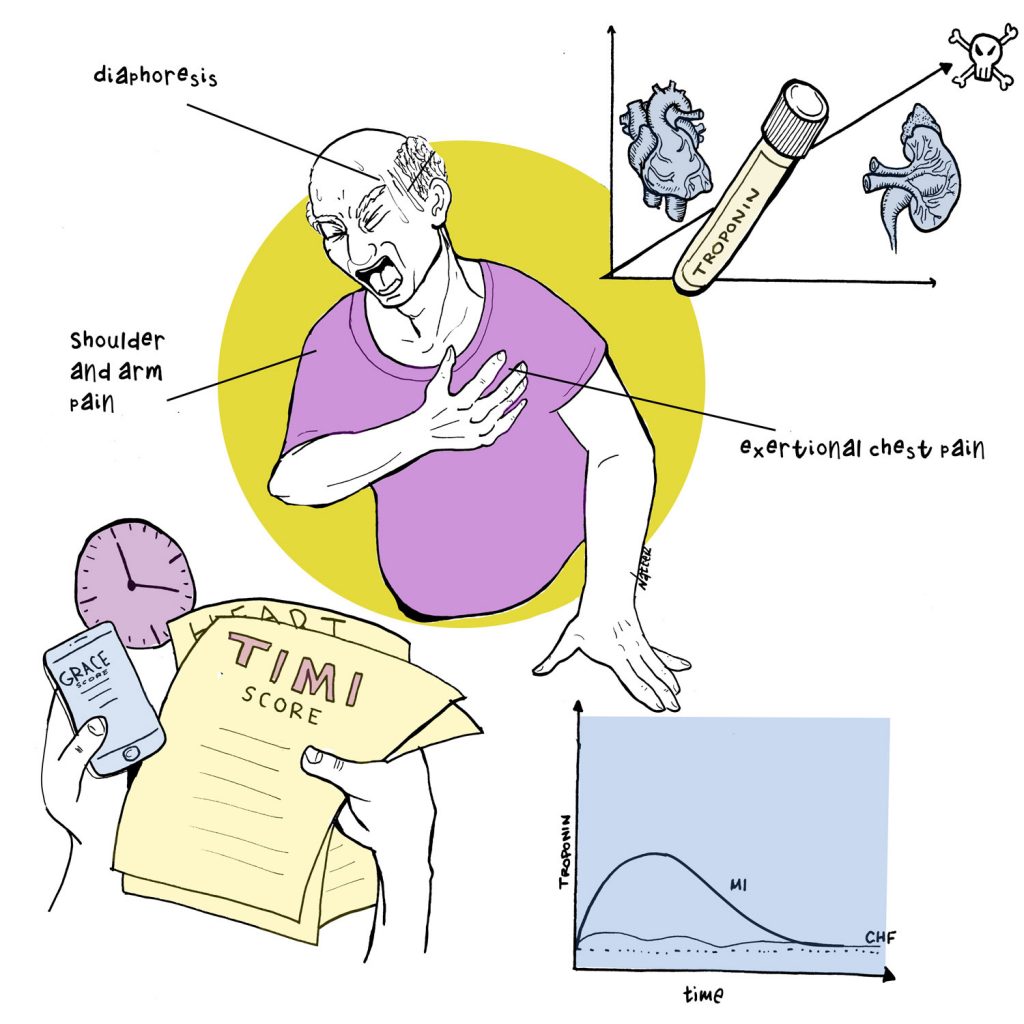
Cardiac biomarkers have historically been a mainstay of the diagnostic criteria of acute coronary syndrome (ACS). Previously utilized cardiac biomarkers include aspartate aminotransferase (AST), lactate dehydrogenase (LDH), and myoglobin; now more often troponin and to a lesser extent creatine kinase-MB are the principal biomarkers used to diagnose ACS.1

Myocardial necrosis and the subsequent loss of cardiomyocyte membrane integrity lead to the release of cardiac biomarkers into the peripheral circulation. Biomarkers, however, do…

Read more »

When Clopidogrel Fails…

March 10, 2010
When Clopidogrel Fails…

Marisa Mizus

Faculty peer reviewed

Clopidogrel (Plavix) has been the standard of care for patients with coronary artery disease following percutaneous coronary intervention (PCI) for the past decade.  Although it is a successful antiplatelet treatment in many patients, like any hero, it has a weakness: formation of its active metabolite depends on two hepatic cytochrome P450 (CYP450)-dependent steps.  Clopidogrel resistance, or non-response, is correlated with an increased risk of major adverse cardiovascular events, including reinfarction and stent thrombosis.(1)  It…

Read more »

When Minutes Matter: Why Do Patients Wait to Seek Treatment Following a Stroke or Heart Attack?

March 3, 2010
When Minutes Matter: Why Do Patients Wait to Seek Treatment Following a Stroke or Heart Attack?

Laurel Geraghty

Faculty peer reviewed

Both stroke and heart attack require rapid treatment following the onset of symptoms to minimize morbidity and mortality, but few patients seek help in a timely manner. Only about half of patients with acute myocardial infarction (AMI) or stroke arrive to the emergency department within four hours of the onset of symptoms.,,, Every 30-minute delay in treatment following AMI increases one-year mortality by 7.5%, and almost half of the 167,000 annual stroke deaths in…

Read more »

Meeting Perspectives: American Heart Association Scientific Sessions 2009

December 16, 2009
Meeting Perspectives: American Heart Association Scientific Sessions 2009

Steven Sedlis, MD


The annual scientific session of the American Heart Association (AHA) was held in Orlando on November 14-18 2009. It felt like a ghost town. I ran into Ira Schulman, my medicine resident at Bellevue when I was a third year medical student; we looked at one another and simultaneously blurted out “where is everybody?” Well Ira remains my role model and hero and it goes to show that although attendance at major…

Read more »