
 Commentary by Cara Litvin MD, Executive Editor, Clinical Correlations
I frowned as my patient handed over some papers to me at a regularly scheduled follow-up clinic visit. For the second time in a row, he had been admitted to an outside hospital for syncope in the interval between his visits with me. The cryptic discharge summaries provided very little information about his work-up. “Follow-up with primary MD” was scribbled on the latest discharge summary, without any test results provided. My initial instinct was to be become angry at my patient for allowing this to happen, but fortunately my more rationale side quickly overcame me as I tried to explain the importance of obtaining detailed records to my patient and his wife.
A recent article in JAMA, “Deficits in Communication and Information Transfer Between Hospital-Based and Primary Care Physicians,” reviews this very issue. The authors of this article extracted data from both observational studies investigating information transfer at hospital discharge and controlled studies evaluating interventions to improve such transfers. Not surprisingly, despite the enormous role adequate communication plays in assuring the provision of quality of care, accurate data evaluating the transmission of information is limited.
A review of observational studies from audits of hospital discharge summaries is unnerving. Discharge summaries frequently did not identify the hospital physician (missing from a median of 25%), diagnostic test results (38%), and specific follow-up plans (14%). Legibility was a concern in 10-50% of the discharge summaries. Outpatient physicians estimated that their subsequent management was adversely affected in nearly one fourth of cases due to inadequate communication.
Eighteen studies evaluating interventions to improve transfer at hospital discharge were included for this review, yet few standardized outcomes were used, making these difficult to interpret. Many of these studies compared computer-generated with manually created discharge summaries and largely favored the computerized summaries.
JCAHO dictates that a complete discharge summary be filed within 30 days of hospital discharge, but this mandate does nothing to ensure that a proper handoff of communication occurs. Based upon their literature review, suggestions proposed by the authors to improve transfers include, first and foremost, the use of an electronic medical record to quickly capture diagnoses and test results in a structured format. Other interventions that have been shown to be effective include directly giving a copy of pertinent data to the patient being discharged, and sending a copy of the discharge summary to the patient’s primary MD.
We can all attest to the fact that, although an intervention such as handing a patient a copy of his records at discharge seems almost too simple, in reality, these trivial actions often fail to occur. The doctors taking care of my clinic patient during his hospitalization knew that he would be following up with a doctor at an outside hospital, yet had not made an effort to provide information that would facilitate his future care. In clinic, my initial reaction was to become upset at my patient, but fortunately I quickly realized that it was really the lack of accountability of his physicians that had frustrated me. In our attempt to discharge patients, we are all inexcusably guilty of hastily planned discharges without proper follow-up. However, in our busy days on the wards, we should bear in mind that complete discharge summaries with adequate plans are often times just as important, if not more important, than the care we provide while the patient is hospitalized.
When taking care of patients in the hospital, we are only very rarely a source of continuity and are usually at the hub of patient transfers. In this era of multiple handoffs, transfer of information is therefore of utmost importance. Unfortunately, this review reveals that transfer of information is a poorly studied phenomenon and an often overlooked barrier to the provision of quality care. However, seemingly effortless actions, such as providing a copy of a discharge summary to the patient or primary physician, have the potential to drastically improve the care a patient receives.
Reference: Kripalani SK, LeFevre F, Phillips CO et al. “Deficits in communication and information transfer between hospital-based and primary care physicians.” JAMA. 2007;297:831-841.
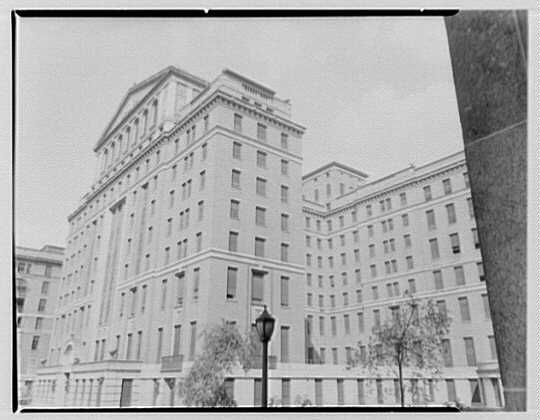
Image of Bellevue Hospital, 1950, courtesy of Wikimedia Commons
2 comments on “The Discharge Summary: A Prerequisite for Quality Care”
My partner and I head two hospitalists groups in the Boston area, one acute care, the other a rehab hospital. For years our handoff communications went through paper mail or fax. We were very diligent about communication. Even so, specialist from acute care settings and primary care physicians in the community complained that our group was like a black box – that they were not getting good communication about the care we were providing. The hospital even setup a physician portal so that any on-staff doctor could log in remotely and access their patient’s information. But this “pull” model never caught on, as most doctors expect data to be “pushed” out to them.
One of our new physicians suggested we look at Concentrica, which is an online network for secure clinical communication. This is free to physicians to communicate with each other. The national directory of physicians meant that we could quickly send to any physician, without having to know their fax or email. Like an online email system, recipients can reply and forward messages, so now we could get immediate feedback from colleagues in other locations, and in important cases, have a real dialog about patient care. The “Group Discussions” feature allows the specialist in town, the hospitalist, and the PCP to all join in an online dialog about one patient. The application works well on our smartphones.
When our group wanted to send documents on our behalf, we upgraded to the subscription version, which cost less than paying someone in our office to fax the documents. There is an audit trail so we can see who received their messages. One feature we really liked was that if the message was not accessed online it was faxed, so we knew our clinical work was getting there.
For our group it made it easy to communicate with other physicians, to get our documents out, gave a way for others to respond, and was cost effective.
Arthur Williams, MD
It boggles my mind to think that something so simple is so difficult to accomplish. The advent of the EHR should really make a lot of this a no-brainer. Document templates could be generated automatically for any type of report (admission/consult/procedure/discharge), and have areas for mandatory documentation (including check-boxes, if desired) and areas for free text documentation. Certainly any information in the mandatory portion can be extracted as needed; so, for example, a document template for a “final progress note” (i.e. the last note prior to discharge) could be created, and there could be a section where it is mandatory that the author document follow-up plans, discharge medications, etc. With OCR, even areas of free-text documentation can be culled for information, if necessary. Anything is possible with technology; the problem is that nobody ASKS us what we WANT and NEED from it. Vendors shove shoddy, incomplete, inefficent software down our throats in a rush to get their programs on the market, and worry about glitches and tweaks later. In the meantime, we are asked to do everything faster and better and more safely (for less money, need I say).
I currently do only administrative PA work, which is dictating discharge summaries. So, if the above ideas were implemented, I’d almost be talking myself out of a job LOL. Still, imagine that you are ready to discharge a patient from the hospital. You go to the computer, open the EHR, pull up the patient, pull in “Final Progress Note” (or discharge note, whatever you end up calling it). There could be a heading that says “Admission Diagnosis,” which could be auto-filled from when the patient was first admitted, so you don’t need to fill it in again. There could be a section that lists which consultants saw the patient; that could be auto-filled in as well, since most EHRs link providers with patients (if they don’t, they should). So that’s another thing you don’t have to manually enter. Any medications the patient is on are already in the system (albeit in a most confusing way, usually), but this could be tweaked to be more user-friendly, so you could see what medications the patient is on, and choose (remember the check-boxes I mentioned) which ones to send him home on, tied into CPOE, so you don’t have to re-enter dosages unless you want to change them. If you miss a medication, an alert can pop up. If you want to discontinue the medication, you override the alert and/or provide an explanation. These can even be done by drop-down menus so that the clinician doesn’t need to enter a lot of free text (e.g. “reason for discontinuing medication (select): contraindicated, changed, redundant, unnecessary,” etc). Discharge diagnoses can be automatically pulled into the form from previous progress notes (depending on how they were entered in the documentation), and the clinician can choose which ones to keep, which ones to omit, etc. There can be a free-text area to document any problems that need further evaluation, testing, follow-up, etc, and actually this too could be an automated feature, by body systems (e.g. the 14 AMA/CMS categories can be visible or can be pulled from a drop-down menu, and the clinician can select by system what needs further management). So if a patient was incidentally noted to have an abnormality on a chest x-ray and needs a follow-up chest x-ray in 3 months, this could be selected from the “pulmonary” system, or, alternatively, there could be a field for “required/recommended x-ray follow-up,” and the clinician can enter “chest x-ray in 3 months” in that field. There are so many ways to make this easier. It just needs to get done! I’ll get off my soapbox now and get back to work…gotta pay the bills…
Comments are closed.