
 By Martin Bouldo
Peer Reviewed
It is not uncommon for individuals to be concerned about where their food comes from. People want to know details like the “country of origin,” or if their eggs came from “cage-free chickens.” For some, like patrons of the Union Square Greenmarket, even getting to know the farmer personally is an important part of their food buying experience. This can naturally raise the question for those already concerned about their nutritional sources, What about my pharmaceuticals? Where do they come from, and what is the process that eventually allows someone to pick them up from the pharmacy window?
Until the mid 1800s, knowing where your pharmaceuticals came from was relatively simple. Generally, and as was the case for Merck (known as Angel Pharmacy then), the local generational family-run pharmacy would make all of their medicines and extracts in-house, following what they called the “art of pharmacy.”1 However, with the advent of the industrial revolution, modern chemistry techniques, increasing specialization, and the consolidation of industry, medicines shifted away from being created by the mom-and-pop apothecary. Instead, they increasingly became the part of a diverse network of industry players designed to optimize the economics of your prescription on a global level.
Atorvastatin
The 18 most prescribed drugs in 2023 (according to ClinCalc) all share their origin in industrial chemical synthesis.2–15 Familiar names like metformin, levothyroxine, lisinopril, amlodipine and metoprolol rank 2 through 6, but dominating the list, with 115 million prescriptions in 2023, the cholesterol medication atorvastatin (Lipitor) is the undisputed champion of American drug prescriptions, optimizing lipid profiles since its FDA approval in 1996.
Although every chemical synthesis process is unique, atorvastatin can be used as a prototypical example to better understand where these medicines originate. Biologically active compounds have critical reliance on stereochemistry, as often their enzymatic interactions, which in this case is inhibiting hydroxymethylglutaryl-coenzyme A (HMG-CoA) reductase, require chiral specificity ((S)-HMG-CoA to (R)-mevalonate).16 Therefore, the manufacturing process starts with what is called a “chiral pool”: a molecule purified against its chirality, such as (L)-malic acid and (R)-epichlorohydrin.17 If you were hoping for a more nature-friendly synthesis, you’d be happy to know that one of the sources of epichlorohydrin is glycerol, which is obtained from plants in biofuel extraction.18 Most of epichlorohydrin actually finds its start from the refinement of crude oil.19 Afterwards, a series of chemical modification steps using traditional organic synthesis is completed. Interestingly, even mid-synthesis, pharmaceuticals benefit from biological processes. Introducing enzymes extracted from Agrobacterium, a soil bacterium, can improve a dehalogenation step in atorvastatin synthesis 4000-fold.17,20 After a few more modification steps and chemical stabilization into a pharmaceutically acceptable salt (using Ca2+), the active ingredient is ready for a binder matrix, such as hydroxypropyl cellulose, a natural derivative extracted from wood pulp.21,22 This complex manufacturing process spans the globe, but knowing your producer is still important to avoid problems such as the 2014 incident where the Indian manufacturer Ranbaxy issued a recall posted to the FDA of 64,000 bottles of atorvastatin 10 mg, due to overdosage in the pills.23
Semaglutide
Transitioning away from synthetics, at rank #19 most-prescribed in 2023, the first nonsynthetic agent appears.14 Novo Nordisk’s diabetes and weight loss drug semaglutide, with 25 million prescriptions, introduces a different class of medicines: the biologics and peptides. These medicines cannot leverage the efficiency and cost savings of traditional industrial chemical synthesis; therefore they cost more. As a result, despite their lower rate of prescription, 7 out of 10 of the most sold drugs by US dollar amount (according to Drug Discovery and Development) are in this category.24 To create semaglutide, an engineered DNA sequence is introduced into Saccharomyces cerevisiae yeast or Escherichia coli bacteria, which then express the peptide while growing in metal bioreactors. The peptide is then harvested from the microorganism, purified via reverse-phase high-performance liquid chromatography, chemically modified, and formulated into an isotonic solution ready for injectable use.25 Novo Nordisk’s OzempicÒ, the highest grossing formulation of semaglutide, mostly centralizes its manufacturing operations in Clayton, North Carolina and Kalundborg, Denmark.26
Pembrolizumab
Even higher grossing is Merck’s cancer drug pembrolizumab (Keytruda), a PDL-1 inhibitor monoclonal antibody that tops the highest earners on the list. Pembrolizumab is FDA-approved for the treatment of over a dozen types of cancer. To start, a gene encoding the desired antibody is inserted into mammalian cells, typically Chinese hamster ovarian (CHO) cells. These are preferred to the cheaper microorganisms mentioned previously, as they can perform the complex post-translational modifications needed for proper antibody function. Afterwards, the hamster cells are cultured to produce and secrete the antibody, which is then purified through chromatography and formulated into the final active ingredient, which is buffered in an aqueous solution.27 Keytruda is currently being made in Ireland, with plans for a billion-dollar investment to begin production of the antibody in Wilmington, Deleware.28
Ultimately, whether your prescription is the result of a classical synthetic chemistry pathway or the output of Chinese hamster ovarian cells in multimillion-dollar bioreactors, the journey from raw material to medicine is anything but simple. What unites them all is the extraordinary network of science, engineering, and coordination of global logistics to ensure that a patient can walk into a pharmacy and leave with the medicine. Just as the food-conscious shopper may take comfort in knowing the story behind their produce, patients may benefit from recognizing that their medications too have a complex, carefully orchestrated origin.
Martin Bouldo is a Class of 2028 medical student at NYU Grossman School of Medicine
Reviewed by Michael Tanner, MD, Executive Editor, Clinical Correlations
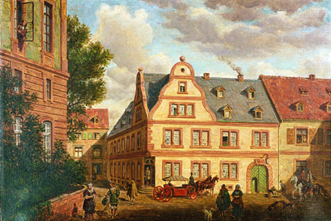
Image courtesy of The Engel Apotheke (Angel Apothecary) in Darmstadt, Germany–the world’s oldest pharmaceutical company and original home of the Merck KGaA. https://commons.wikimedia.org/wiki/File:ENGEL_APHOTHEKE.png
References
- The history of Merck. https://merck.online-report.eu/2009/ar/merck2009ataglance/aboutmerck/history.html Published February 18, 2010. Accessed August 26, 2025.
- Raghava Reddy AV, Garaga S, Takshinamoorthy C, Naidu A, Dandala R. Synthesis and characterization of compounds related to lisinopril. Sci Pharm. 2016;84(2):269-278.
- Mehra J, Choubey A, Srivastava B, Porwal R, Gautam P. Metoprolol manufacturing process. US patent US20050107635A1. https://patents.google.com/patent/US20050107635A1/en Published May 19, 2005. Accessed August 26, 2025.
- Economou J, McPhillips A, Smoliga J, Wilson R. Stable sertraline hydrochloride formulation and method. US patent US20060257475A1. https://patents.google.com/patent/US20060257475A1/en Published November 16, 2006. Accessed August 26, 2025.
- Hernández-Velázquez ED, Alba-Betancourt C, Alonso-Castro ÁJ, et al. Metformin, a biological and synthetic overview. Bioorg Med Chem Lett. 2023;86:129241. doi:10.1016/j.bmcl.2023.129241
- Wu C, Xiang H, Yu X, et al. Process for preparing bupropion hydrochloride. US patent US7737302B2. https://patents.google.com/patent/US7737302B2/en Published June 15, 2010. Accessed August 26, 2025.
- Dolitzky BZ. Processes for preparing losartan and losartan potassium. US patent US7041832B2. https://patents.google.com/patent/US7041832B2/en Published May 9, 2006. Accessed August 26, 2025.
- Kumar A, Soudagar SR, Nijasure AM, Panda NB, Gautam P, Thakur GR. Process for synthesis of gabapentin. US patent US20080103334A1. https://patents.google.com/patent/US20080103334A1/en Published May 1, 2008. Accessed August 26, 2025.
- Bengtsson IS, Lovgren KI. Pharmaceutical formulation of omeprazole. US patent US5690960A. https://patents.google.com/patent/US5690960A/en Published November 25, 1997. Accessed August 26, 2025.
- Kankan RN, Srinivas PL. Process for the preparation of pantoprazole sodium. WO patent WO2006064249A2. https://patents.google.com/patent/WO2006064249A2/en Published June 22, 2006. Accessed August 26, 2025.
- Kaushik VK, Mohammed UK, Meenakshisunderam S. Process for the preparation of escitalopram. US patent US7939680B2. https://patents.google.com/patent/US7939680B2/en Published May 10, 2011. Accessed August 26, 2025.
- Feng H, Heinicke G. Amphetamine formulations. US patent US20060204575A1. https://patents.google.com/patent/US20060204575A1/en Published September 14, 2006. Accessed August 26, 2025.
- Stowell GW, Whittle RR. Form A of fluoxetine hydrochloride. US patent US6313350B1. https://patents.google.com/patent/US6313350B1/en Published November 6, 2001. Accessed August 26, 2025.
- The top 200 of 2023. https://clincalc.com/drugstats/Top200Drugs.aspx Accessed August 26, 2025.
- Shanmugam M, Arunkumar S. Hydrochlorothiazide compositions. US patent US20230111273A1. https://patents.google.com/patent/US20230111273A1/en Published April 13, 2023. Accessed August 26, 2025.
- Ma SM, Garcia DE, Redding-Johanson AM, et al. Optimization of a heterologous mevalonate pathway through the use of variant HMG-CoA reductases. Metab Eng. 2011;13(5):588-597.
- Tao J, Xu JH. Biocatalysis in development of green pharmaceutical processes. Curr Opin Chem Biol. 2009;13(1):43-50.
- Almena A, Martín M. Technoeconomic analysis of the production of epichlorohydrin from glycerol. Ind Eng Chem Res. 2016;55(12):3226-3238.
- Sienel G, Rieth R, Rowbottom KT. Epoxides. In: Ullmann’s Encyclopedia of Industrial Chemistry. John Wiley & Sons; 2000.
- Fauzi AM, Hardman DJ, Bull AT. Biodehalogenation of low concentrations of 1,3-dichloropropanol by mono- and mixed cultures of bacteria. Appl Microbiol Biotechnol. 1996;46(5-6):660-666.
- Salazar-Barrantes KA, Abdala-Saiz A, Vega-Baudrit JR, Navarro-Hoyos M, Araya-Sibaja AM. Formulation and evaluation of atorvastatin calcium trihydrate Form I tablets. PLoS One. 2025;20(2):e0317407.
- Zhang J, Guo M, Luo M, Cai T. Advances in the development of amorphous solid dispersions: The role of polymeric carriers. Asian J Pharm Sci. 2023;18(4):100834.
- India’s Ranbaxy issues massive recall of generic Lipitor. CNBC. https://www.cnbc.com/2014/03/07/indias-ranbaxy-issues-massive-recall-of-generic-lipitor.html Published March 7, 2014. Accessed August 26, 2025.
- Buntz B. 2024’s blockbusters: Top 25 drugs by sales. Drug Discovery and Development. https://www.drugdiscoverytrends.com/2024s-blockbusters-top-50-pharmaceuticals-by-sales/ Published April 4, 2025. Accessed August 27, 2025.
- Jensen CB. Use of long-acting GLP-1 peptides. US patent US10335462B2. https://patents.google.com/patent/US10335462B2/en Published July 2, 2019. Accessed August 26, 2025.
- Eanes Z. Ozempic maker Novo Nordisk plans major expansion in the Triangle. Axios. https://www.axios.com/local/raleigh/2024/06/24/ozempic-maker-novo-nordisk-triangle-north-carolina-expansion Published June 24, 2024. Accessed August 26, 2025.
- Spadiut O, Capone S, Krainer F, Glieder A, Herwig C. Microbials for the production of monoclonal antibodies and antibody fragments. Trends Biotechnol. 2014;32(1):54-60.
- DiStefano J. Merck plans to move manufacturing of its main drug, Keytruda, to a new US factory and lab in Delaware. Inquirer.com. https://www.inquirer.com/business/health/cancer-drug-manufacturing-merck-delaware-20250429.html Published April 29, 2025. Accessed August 26, 2025.